FIELD NOTES 001
A little space.
A lot less fragile.
We built a small settings panel to explain responsive UI. Its first failure came from a control we weren’t watching.
Can the menu explain itself?
A good teaching example should survive the first reasonable change someone makes to it.
For H2S2’s first UI field note, that change was simple: make the window narrower. Then make the description longer. Then increase the theme’s text size. Finally, replace the settings panel with a fresh instance of the same saved scene.
The paired Guide explains how to build the result. This Journal is about the decisions behind the experiment. It describes a new studio teaching project, not an interface we have already shipped in Mithraeum.
Keep the relationship.
Let the space change.
The visual treatment follows the same idea. Our paired lights become two reference points. A plum frame changes width between them. The movement shows a relationship that is hard to read from one frozen inspector screenshot.
The panel wasn’t the whole problem.
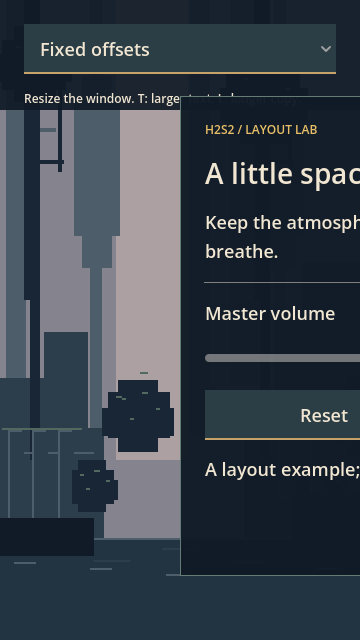
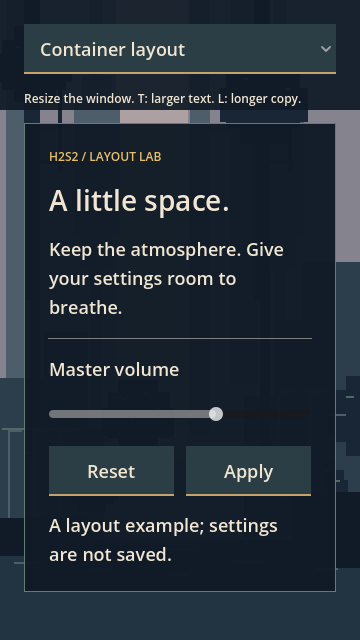
The first version used containers for the settings panel, but our 360-pixel test still failed at theme font size 24. The mode selector’s longer comparison label contributed a minimum width larger than the available space.
That is a better lesson than a perfect first screenshot. “Use containers” does not mean “all content will fit.” The layout chain includes siblings, minimum sizes, style padding and the words themselves. The control you are trying to fix may be respecting an impossible request from somewhere else.
We shortened the selector choices and disabled its longest-item fitting behavior. The corrected cases passed the horizontal bounds checks. For the content that genuinely needed more space, we kept wrapping and vertical scrolling rather than trying to hide the overflow or shrink the text.
Structure, skin, and the explanation.
The scene owns the structure. A frame provides margins. A stack arranges the sections. A nested scene contains the panel. The script connects the demonstration controls; it does not reposition the buttons on each resize. That keeps the reason for each rectangle visible in the scene tree.
The theme owns the shared appearance. Gold action borders, plum panels and warm text come from one resource on the host. The panel inherits it. For the larger-text comparison, the demo duplicates the theme before changing it, so a local experiment does not mutate another instance’s shared resource.
The animation owns the explanation. We could have shown an inspector recording alone. Instead, the Guide lets a reader move one boundary at a time in a browser model, then compare that simplified picture with real Godot captures. The illustration is labeled because it does not execute Godot’s layout engine.
The native result does not ease between layout passes. The browser’s deliberate motion helps trace the changing space. It can be paused, and reduced-motion preferences retain the useful controls and still composition.
THE COST OF KEEPING IT SMALL
The two action labels stay short. There is no automatic horizontal-to-vertical row switch. We accepted that limit for this example so the relationship between parent bounds, minimum sizes and expansion stays visible.
A modest result is still a useful one.
The local geometry test exercised two widths, two theme font sizes and two description lengths. It repeated those eight combinations with a replacement panel instance: sixteen passing cases. It also checked the intentionally broken fixed panel and the container’s response to a manually displaced action button.
The tests ran on Godot 4.7.2.stable.official.ed1daf0bf. The captures used macOS and the Compatibility/OpenGL renderer. The evidence manifest records the archive checksum and geometry results, so the result is tied to the example we are sharing.
Those checks do not establish full localization coverage, controller navigation, mobile safe-area handling or performance across devices. Replacing the panel tested layout reuse, not a complete scene lifecycle or every signal reconnection. We have not measured whether this article improves a reader’s learning or conversion to game interest.
What it does give us is a small example with a clear failure, a visible reason for the fix, and enough exposed structure for someone else to change it. That is the standard we want these field notes to meet.
Prepared for H2S2 Studio with Codex. Automated technical checks and capture inspection: November 2, 2026. Technical review information and evidence are recorded above. Official technical references are linked in the paired Guide.